
American Women Are Leading the Winter Olympics — So Why Isn’t the Coverage Equal?
Imagine dedicating your entire life to a sport, training tirelessly, sacrificing weekends, holidays, and social events, only to have your achievements consistently overshadowed or minimized. For women in sports, this has been the reality for decades. From the earliest days of professional athletics to the global stage of the Olympics, women’s contributions have often been underestimated, underreported, or simply ignored.
2026 Olympics: Who Runs the World?
This year, at the Winter Olympics, American women proved once again that they are not just participants, they are leaders. According to USA Today, Team USA’s women earned 17 medals overall, including six golds, while the men earned 12 medals with four golds. Remarkably, this marks the third consecutive Winter Olympics where U.S. women have outpaced the men in total medals, cementing their role as the backbone of the American team. Across sports like alpine skiing, snowboarding, figure skating, freestyle skiing, and hockey, female athletes consistently delivered performances that were not only competitive but historic. This trend is a continuation of past Winter Games, including the Beijing Olympics, where women also captured the majority of the United States’ medals.
The Persistent Media Coverage Gap
Yet, despite these undeniable successes, media coverage often fails to reflect their achievements. Studies over the years consistently show that women’s sports receive less airtime, fewer feature stories, and less social media attention compared to men’s sports. Even during the Olympics, arguably the world’s most visible sporting stage, women’s victories are oftentimes framed around personality, appearance, or personal narratives rather than athletic skill.
Less Coverage: Snubbed Despite the Gold
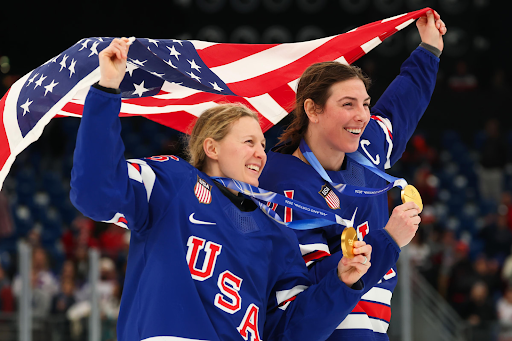
A clear example comes from the U.S. gold medal hockey games this year. The women’s final took place midday on Friday, February 20th, during the workday and well before the closing ceremony. The men’s final, however, occurred at 8 a.m. U.S. time (2 p.m. Italy time) on Sunday, February 22nd, as the last Olympic event of the games, giving it a larger spotlight by default. On social media, the disparity is stark: ESPN posted roughly 31 times about the men’s hockey team on their gold medal day, compared to just five posts about the women’s hockey team. That same day, figure skater Alysa Liu also won gold, yet the combined attention for both her and the hockey team amounted to only nine posts, illustrating a clear imbalance in coverage.
This isn’t an isolated incident. One gender-representation study by SCRIBD of ESPN’s Instagram account found 165 posts about men’s sports compared to just 15 about women’s sports over a 14-day period. While media coverage for women has improved over the decades, the gap remains noticeable. Social media allows athletes to tell their own stories, and broadcasters are slowly investing more in women’s events. However, when female athletes bring home gold yet receive disproportionate attention, the underlying message to fans, sponsors, and young aspiring athletes is contradictory.
Representation and Inclusion Matter
Equal visibility matters. Media shapes public perception, and young girls watching the Olympics deserve to see women portrayed as elite competitors first, not as secondary storylines. Proper coverage can influence sponsorship opportunities, funding, and long-term growth for women’s winter sports programs. Beyond that, when journalists break down technique, strategy, and statistics for female athletes with the same analytical depth afforded to men, it validates women’s sports at every level and reinforces that their achievements are not “less than” but equally remarkable.
The recent Winter Olympics should serve as a turning point. If American women are consistently leading Team USA in success, their media presence should finally reflect that leadership. Equal achievement deserves equal visibility, not as a symbolic gesture, but as an accurate representation of reality. For athletes who dedicate their lives to their craft, recognition isn’t just nice to have, it’s the acknowledgment they’ve earned and a message to the next generation that women belong at the top of the podium, in the spotlight, and in history.
Final Thoughts: Passion for Sports
I have always felt a deep and enduring passion for the Olympics and for women’s sports. Growing up watching athletes compete on the world stage, I was inspired not just by their skill and dedication, but by the way sports can unite people and showcase human potential. As a Sport Management major, my studies have given me a closer look at the inner workings of the sports industry, and it has become clear to me that while incredible progress has been made, there is still a significant gap when it comes to representation, recognition, and opportunity for female athletes. My passion for women’s sports drives me to want to be part of that change. I hope to contribute to a future where female athletes are represented as equitably as their male counterparts, where young girls can see themselves reflected in every podium, every broadcast, and every leadership role within sports organizations.
About Katherine
Katherine is a current sophomore pursuing a degree in Sport Management with minors in Advertising and Public Relations and Hospitality and Tourism Management. She is currently an Account Associate for GrandPR. She hopes to work the 2028 Summer Olympics in Los Angeles, California.